Why Yosemite Is the Waterfall Capital of America
Few places concentrate so much falling water in so small a space. The granite walls of Yosemite Valley were carved by glaciers into U-shaped cliffs, leaving the side streams that once fed the old V-shaped river canyon stranded high above the floor. Those streams now spill off the rim as 'hanging valley' waterfalls, dropping hundreds or even thousands of feet in a single view. Within roughly seven miles of valley road you can stand beneath Yosemite Falls, Bridalveil Fall, and the Merced River's Vernal and Nevada Falls, and from the right turnouts catch Horsetail Fall on El Capitan and Sentinel and Ribbon falls when they run.
What makes Yosemite different from most waterfall regions is not just height but reliability of spectacle on a predictable calendar. The Sierra Nevada banks its water as winter snowpack, then releases it as melt. That means the valley's falls are fed less by rainstorms than by the slow thaw of the high country, and the show builds toward a roaring late-spring crescendo. The National Park Service flags this directly in its visitor planning materials: 'Yosemite's waterfalls are usually best in May and June' for peak flow.
The catch is that the same dynamic makes many falls seasonal. By late summer the snowpack is gone and several famous cascades thin to a trickle or stop entirely. Yosemite Falls, the park's headline cataract, frequently runs dry in late summer and early fall before winter storms revive it. Plan around the water, not just the calendar: an April-through-June trip rewards you with falls at full volume, while an August visit may show you bare granite where a 2,000-foot ribbon hung two months earlier.
A note on the numbers throughout this guide: reported waterfall heights vary by source and by how the drop is measured (single plunge versus the full tiered cascade, surveyed versus estimated). We cite the figures the National Park Service and standard references use, but treat any single foot-count as approximate rather than exact.
Yosemite Falls — North America's Tallest Showpiece
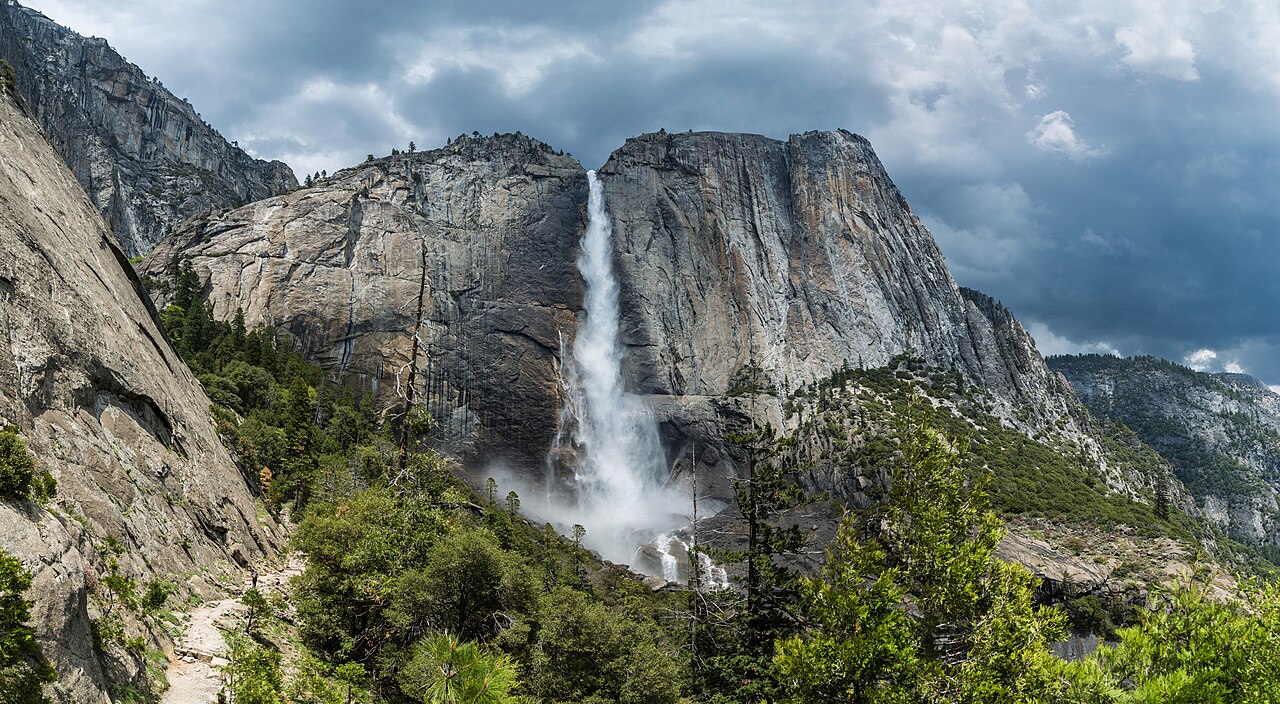
Yosemite Falls is the centerpiece and the reason many people drive into the valley at all. At a commonly cited 2,425 feet, it is among the tallest waterfalls in North America, but that figure is the total of three connected drops, not a single plunge: the Upper Fall (about 1,430 feet), a churning section of middle cascades, and the Lower Fall (about 320 feet). From Cook's Meadow on the valley floor you can take in the whole tiered system at once, framed by granite.
You do not have to hike to enjoy it. The Lower Yosemite Fall trail is a short, mostly paved loop (roughly one mile round trip) that brings you to a footbridge in the mist of the lowest drop — easy, family-friendly, and spectacular at peak flow. For the full experience, the Yosemite Falls Trail climbs to the very top. That is a serious undertaking: about 7.2 miles round trip, gaining some 2,700 feet on relentless switchbacks, rated strenuous, and best treated as most of a day. The reward is standing at the brink where Yosemite Creek launches off the rim.
Timing is everything here. The best season is spring snowmelt, roughly April through June, when the fall thunders and throws mist across the lower bridge. Because Yosemite Creek drains a high basin with no glacier to sustain it, the fall typically dwindles through summer and can stop completely by late August, returning only with autumn and winter precipitation. If a booming Yosemite Falls is the image you are chasing, go in May or June and accept that a September visit may show you a dry cliff.
On nights around the full moon in spring, when flow and moonlight are both strong, the lower fall sometimes produces a 'moonbow' — a faint lunar rainbow in the mist. It is not guaranteed, but it is a reason some photographers time their trip to the lunar calendar rather than just the season.
Bridalveil and Horsetail — The Two-Week Wonders and the Easy Wins
Bridalveil Fall is often the first waterfall visitors meet, since it hangs near the valley's western entrance and is visible from the road. Fed by Bridalveil Creek, it drops about 617 feet in a single plunge, and in spring afternoon wind the falling water frays sideways into the gauzy 'veil' that gives it its name. The trail is short and easy — roughly a half mile round trip on a paved, partially uphill path to the viewing area at the base, where spray can soak you when flow is high. Like the valley's other falls it peaks with spring snowmelt (April through June), but Bridalveil is more persistent than most and usually keeps at least some flow year-round.
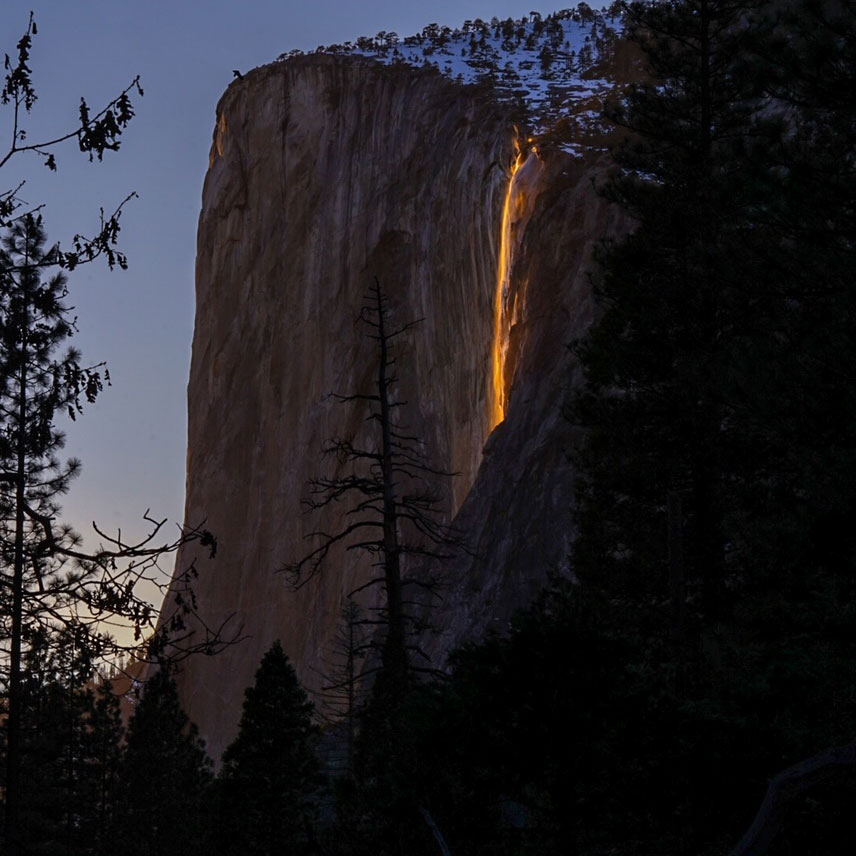
Horsetail Fall is the valley's most famous two-week wonder. This seasonal horsetail on the east face of El Capitan reaches a reported 1,570 feet and only flows when there is enough snowmelt to feed it. Its fame comes from optics rather than size: for a brief window in mid-to-late February, if the creek is running and the western sky is clear at sunset, the low-angle light can ignite the thin ribbon of water so it glows orange and red like flowing lava — the modern 'firefall.' The event is so popular that the Park Service manages access and parking near El Capitan during the February window, so check current-year NPS guidance before you go.
Reaching the Horsetail viewing area is easy on foot — figure around 1.5 miles round trip from the designated parking to the El Capitan Picnic Area and roadside vantages, on flat ground. The difficulty is not the walk but the conditions: you need the right two weeks of February, water in the creek, and an unobstructed clear western horizon at the exact moment of sunset. Many visitors come on a perfect-looking evening and see nothing because a thin bank of clouds on the horizon blocks the light. Build in multiple evenings if the glow is your goal.
Together these two falls bracket the valley's range: Bridalveil is the dependable, low-effort classic you can visit on any spring day, while Horsetail is the high-variance, calendar-locked spectacle that rewards planning and a little luck.
Vernal and Nevada — The Merced River Staircase
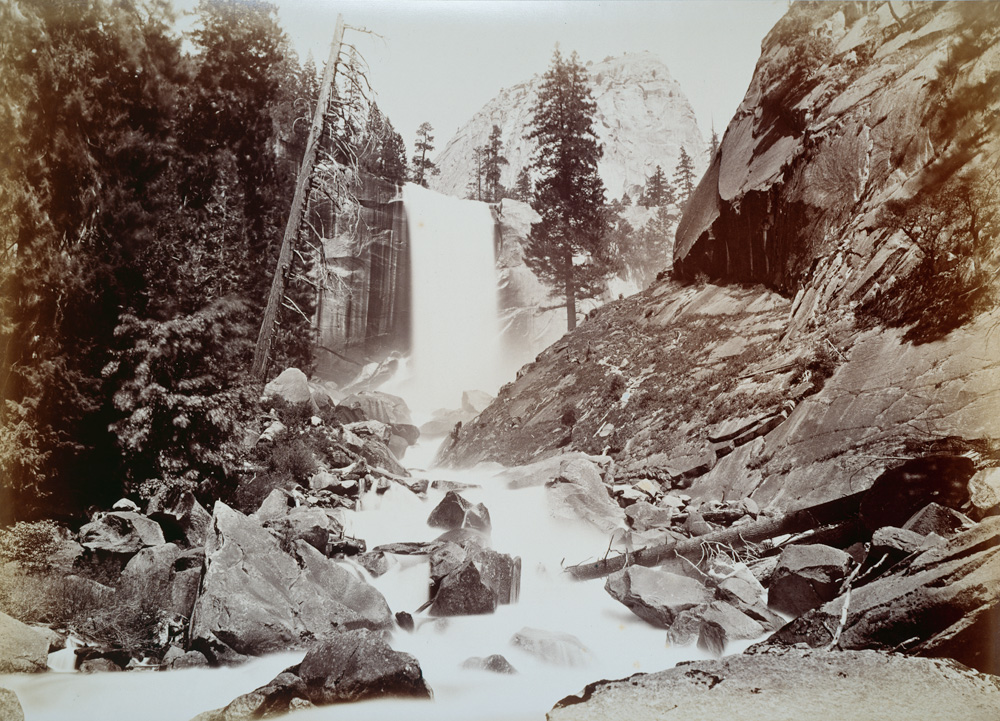
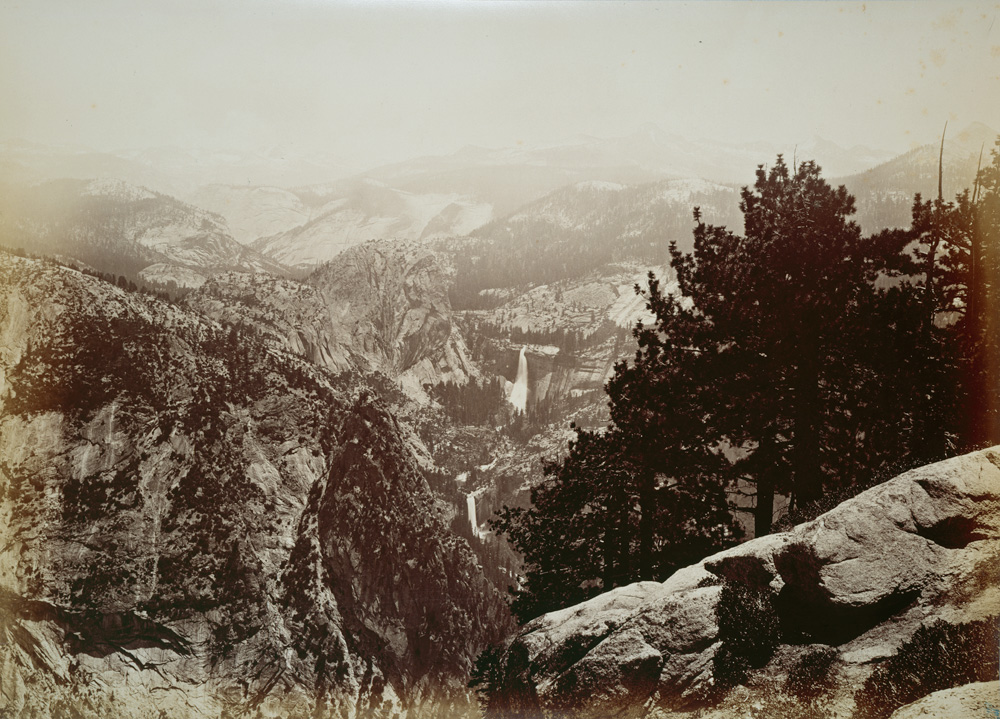
Above the eastern end of the valley, the Merced River descends a granite 'Giant Staircase' in two great steps: Vernal Fall and, higher up, Nevada Fall. They are reached by the same famous corridor — the Mist Trail — and many hikers do both in one strenuous outing. Vernal Fall is a broad block-form drop of about 317 feet; Nevada Fall above it falls roughly 594 feet in a more angled, horsetail-like sweep against the shoulder of Liberty Cap.
The Mist Trail earns its name. To reach the top of Vernal Fall you climb roughly 3 miles round trip up a steep stone stairway cut into the cliff beside the cascade, and at peak flow the falling water drenches the trail in spray — exhilarating, and slick. The Park Service rates this section strenuous and warns that the granite steps become genuinely dangerous when wet; sturdy footwear and caution are not optional. Continuing past Vernal to the top of Nevada Fall extends the trip to about 5.4 miles round trip with substantial additional climbing, and the loop down the John Muir Trail offers a less wet, more gradual return with classic views back at Nevada Fall.
Both falls run on the Merced's snowmelt, so they are at their thundering best in late spring — generally May into June — when the river is high and the Mist Trail's spray is at full force. As the season dries out, the falls shrink and the misting subsides; by late summer you can often walk the lower steps without getting wet, which is safer but far less dramatic. For peak flow and the full soaking experience, aim for that May-to-June window.
A practical caution that applies all the way up this drainage: the rock above and beside these falls is polished and slippery, the current at the brink is powerful, and there are railings and warning signs for good reason. People have died wading or scrambling near the lips of Vernal and Nevada in high water. Stay behind barriers and out of the river above the falls.
Wapama Falls — The Hetch Hetchy Alternative
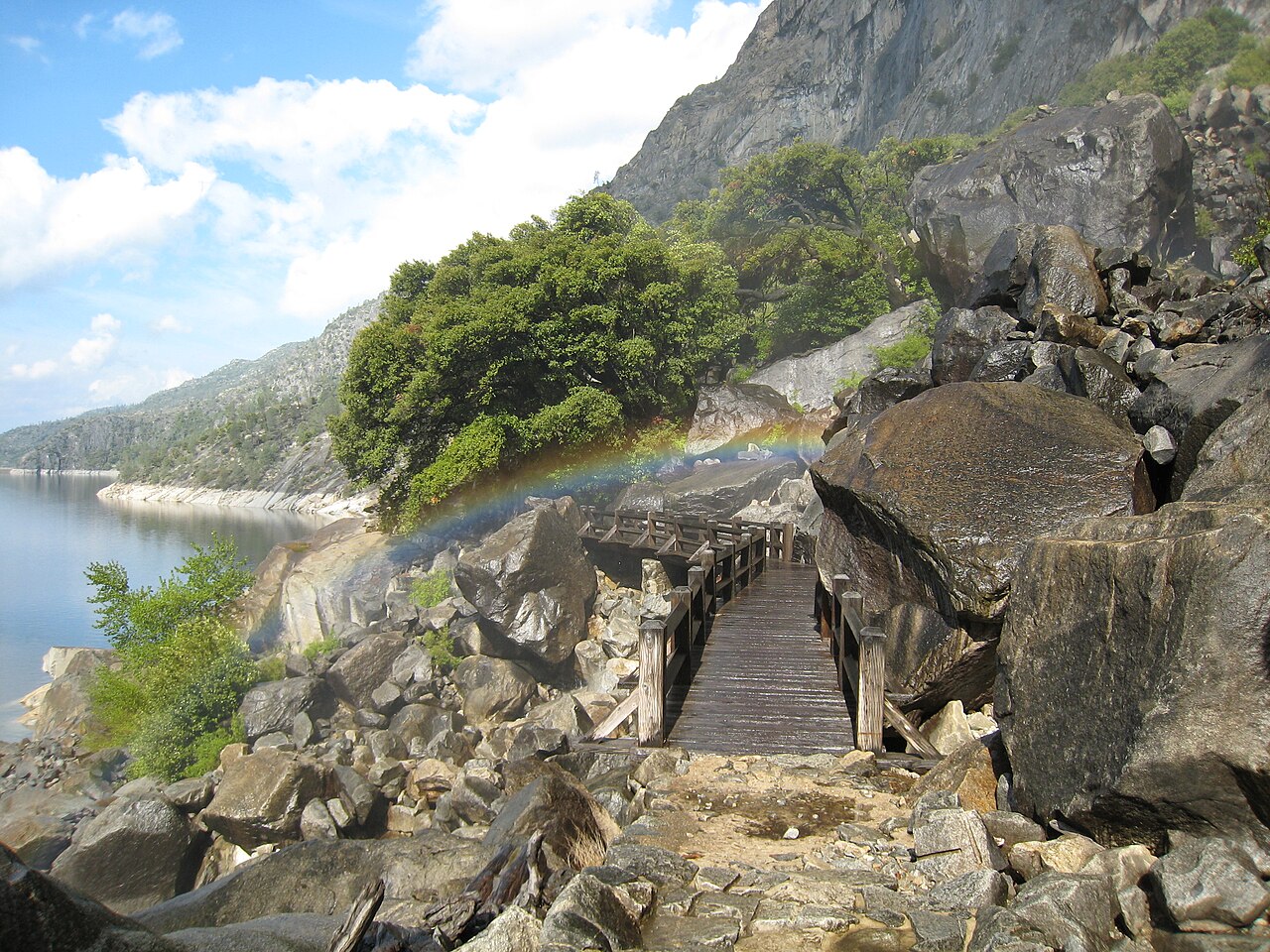
Most visitors never leave Yosemite Valley, but the park's northwest corner holds Hetch Hetchy, a reservoir-filled valley that John Muir once compared to Yosemite Valley itself. Its signature waterfall is Wapama Falls, a horsetail on Falls Creek that drops about 1,080 feet in stepped cascades onto the rocks at the reservoir's edge. Because the trailhead sits in a lower, warmer part of the park, Hetch Hetchy's falls tend to peak a bit earlier in the year than the high-fed valley falls.
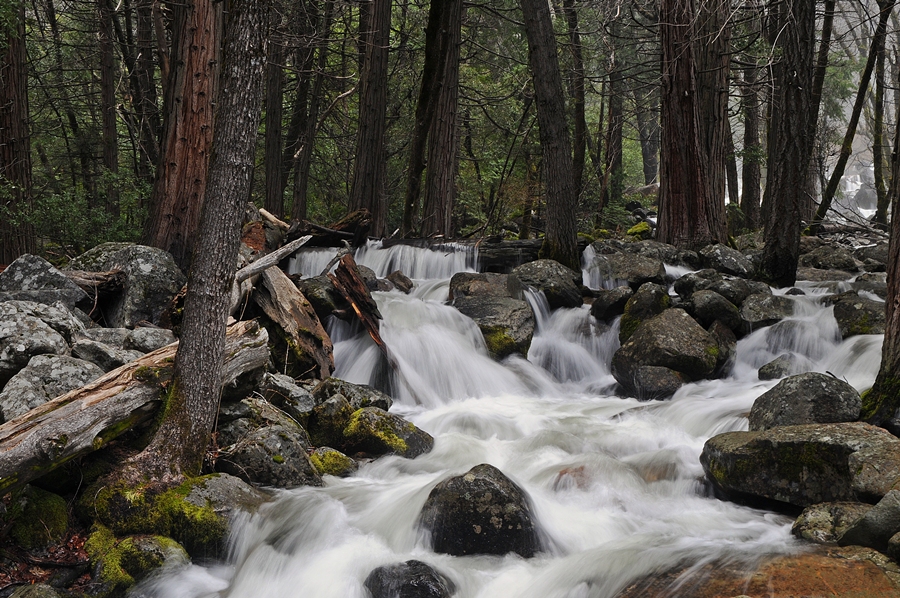
Reaching Wapama is a moderate hike of roughly 5 miles round trip from the O'Shaughnessy Dam, following a mostly gentle trail along the north shore of the reservoir, passing the slender Tueeulala Fall along the way before arriving at a series of footbridges directly beneath Wapama's lowest cascades. At high water in spring those bridges can be awash — the Park Service periodically closes them when flow is dangerous — so check conditions before counting on crossing. The nearest gateway community is Mather, and note that the Hetch Hetchy entrance has its own restricted gate hours, unlike the round-the-clock valley.
The best season here is spring, roughly April into May, when Falls Creek is swollen with snowmelt and Wapama roars onto the footbridges. By summer the flow drops sharply and the bridges are an easy dry crossing, while Tueeulala beside it often disappears entirely. For solitude and full-volume water without valley crowds, an April Hetch Hetchy visit is one of the park's best-kept waterfall outings.
Wapama makes a useful contrast to the valley giants: it is taller than Bridalveil and Nevada, it sits in a quieter part of the park, and the level lakeside approach makes it more attainable for hikers who find the Mist Trail or Upper Yosemite Falls climb too steep.
Planning Your Yosemite Waterfall Trip
Sequence your visit around peak flow. The single most important planning decision is timing: April through June is the heart of waterfall season across the park, with the valley falls usually thundering hardest in May and June and Hetch Hetchy peaking a little earlier. A spring trip almost guarantees full-volume Yosemite Falls, Bridalveil, Vernal, Nevada, and Wapama. The lone exception is Horsetail Fall, whose 'firefall' glow is locked to mid-to-late February and requires both flowing water and a clear western horizon at sunset.
Match the hike to your group. For a low-effort waterfall day you can pair the paved Lower Yosemite Fall loop (about 1 mile) with the short Bridalveil Fall walk (about 0.5 mile) and see two of the park's icons up close. For something more ambitious, the Mist Trail to the top of Vernal Fall (about 3 miles round trip, strenuous) and on to Nevada Fall (about 5.4 miles round trip) is the classic half-day workout, while the full Yosemite Falls Trail to the rim (about 7.2 miles round trip, strenuous, ~2,700 feet of gain) is a serious all-day climb. Carry water, start early to beat heat and crowds, and wear shoes with grip for the wet, polished granite.
Mind the logistics and the hazards. Yosemite's peak waterfall season overlaps with its busiest months, so expect full parking lots and, in many recent years, a reservation requirement for valley entry during high-demand periods — check current NPS guidance before you drive in. Spring also means high, cold, fast water: the brinks of Vernal, Nevada, and Yosemite Falls have all been the sites of fatal accidents, and the rocks beside them are far more slippery than they look. Stay behind railings, keep out of the river above any fall, and treat the Mist Trail's wet stone steps with respect.
Finally, build in a backup. Waterfalls are weather- and snowpack-dependent, and a dry winter can mute even the spring show while a banner snow year can keep the falls roaring into July. If you have flexibility, watch the season's snowpack reports and the park's current conditions page, and keep a Hetch Hetchy day in your back pocket — it peaks earliest and draws the smallest crowds when the valley is at its busiest.