The One Idea Behind Silky Water: Shutter Speed
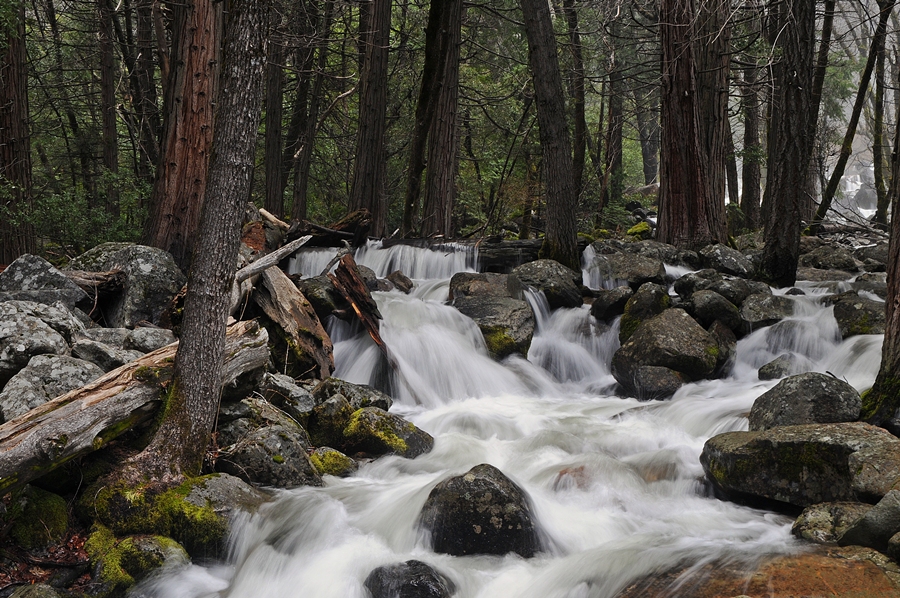
Every waterfall photograph is really a decision about time. Your shutter speed is the length of the window during which the camera's sensor collects light, and it determines whether moving water looks frozen mid-splash or blurred into a smooth, flowing veil. A fast shutter (say 1/1000 of a second) catches the water in a single sliver of a moment, so individual droplets hang crisp in the air. A slow shutter (a full second or more) lets the water move across the frame while the sensor is still recording, and all those positions blend together into the soft, silky streaks that drew you to this style in the first place.
For the classic silky look, most photographers work somewhere between roughly 1/4 second and 2 seconds. Around 1/2 to 1 second is a reliable starting point: long enough to smooth the flow, short enough that the water still shows texture and direction rather than dissolving into a featureless white blur. The right number depends on how fast the water is actually moving. A thundering high-volume drop blurs in a fraction of a second, while a thin, lazy trickle may need several seconds to register the same effect. There is no single 'correct' value, so bracket: shoot the same composition at 1/4, 1/2, 1, and 2 seconds and compare on a big screen later.
The opposite choice is just as valid. Freezing the water at 1/500 to 1/2000 second captures raw power and the chaotic geometry of spray, which suits a violent plunge far better than a gentle smear would. A tall, forceful column like Bridalveil Fall in Yosemite (a 620-foot plunge that gets blasted sideways by canyon wind in spring) can look more honest frozen than silked, because the wind-driven veil that gives the fall its name is part of the subject. Decide which story you are telling before you set the shutter: serene and timeless, or powerful and immediate.
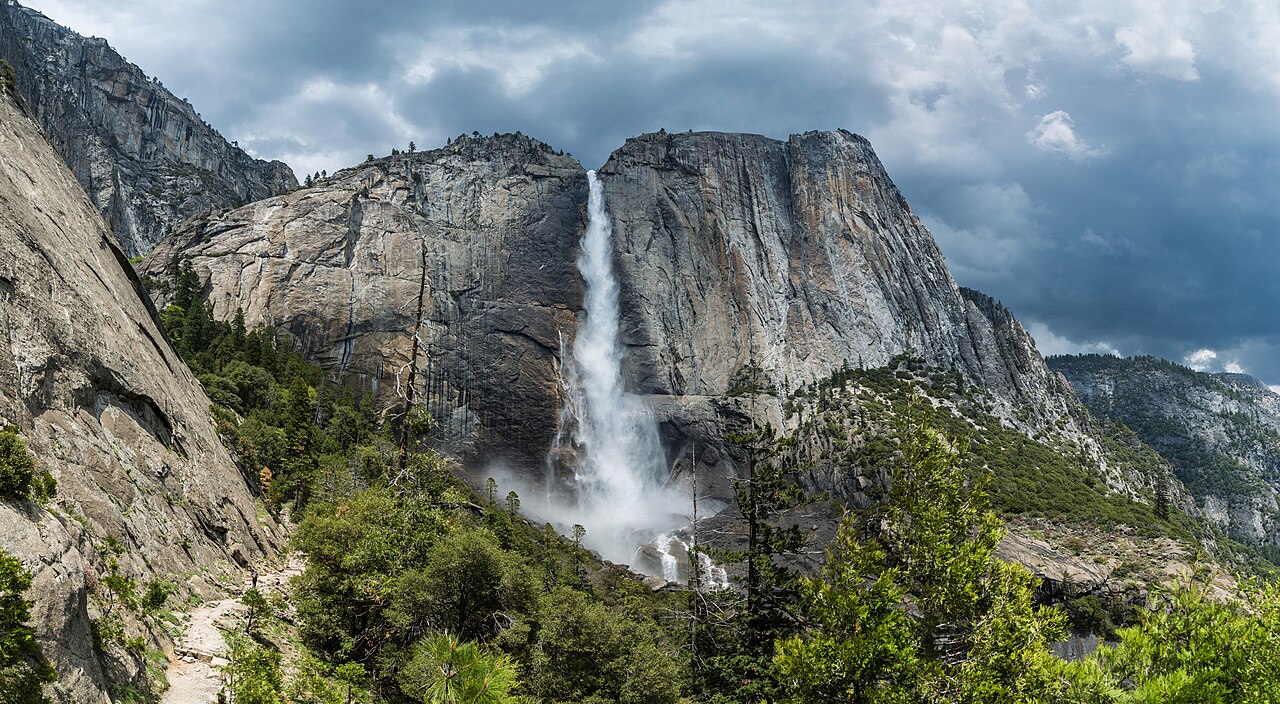
Keep in mind that height figures themselves carry uncertainty, which matters when you plan a shot. Reported drops vary by source and measurement method, and a single cumulative number can hide the structure you actually photograph. Yosemite Falls is widely cited at 2,425 feet, but that total spans three distinct sections (Upper Fall, the middle cascades, and Lower Fall), not one continuous curtain. Multnomah Falls in Oregon is generally given as 620 feet across its two tiers. Treat these numbers as well-documented estimates, not surveyed certainties, and frame for what your eye and the structure tell you rather than for a headline figure.
Gear: The Tripod Is Non-Negotiable
Once your shutter is open for half a second or longer, no human hand is steady enough to keep the camera still. Any movement during the exposure smears the rocks, trees, and the falls themselves into a soft mess, ruining the one thing you came for. A tripod is therefore the single most important piece of equipment for silky water, more important than the camera body or the lens. Set it up on solid ground, splay the legs wide for stability on uneven terrain, and avoid extending the thin center column if you can, since that is the wobbliest part of any tripod.
To eliminate the last source of vibration, your own finger, trigger the shutter without touching the camera. Use a remote release or your camera's app, or simply set the two-second self-timer so the body settles before the exposure begins. On a DSLR, enabling mirror lock-up or the electronic shutter removes the tiny internal slap that can blur very long exposures. These habits cost nothing and are the difference between sharp foreground rock and a frustratingly soft frame.
Beyond the tripod, your kit can be modest. A mid-range zoom covering wide to short telephoto handles most scenes: wide to take in the full height of a tall fall, longer to isolate a single tier or a detail of water sliding over rock. A wide-angle is genuinely useful at sites with a close, low overlook, such as the lower viewing area at Multnomah Falls, where you stand only a couple hundred feet up the paved path from the base and the 620-foot fall towers above you. Bring a microfiber cloth, too: at the base of any powerful waterfall, drifting mist will coat your front element within seconds and show up as ugly soft blobs if you do not wipe between frames.
Dress and pack for the environment, because the best waterfall conditions are also the wettest. Spring snowmelt, the peak season for Yosemite Falls, Bridalveil Fall, and Virginia's Crabtree Falls (April through June), means heavy flow, slick rock, and chilly spray. The 3.4-mile trail up Crabtree Falls in the George Washington National Forest gains significant elevation past a series of cascades that together drop a frequently cited 1,000 feet, so a weather-sealed bag, secure footing, and a willingness to get a little wet matter as much as any lens you carry.
Filters: How to Get Long Exposures in Bright Light
The frustrating paradox of silky water is that the conditions you want, a slow shutter, fight the conditions you often have, plenty of daylight. Even at your smallest aperture and lowest ISO, a one-second exposure in afternoon sun will be hopelessly overexposed, blown out to pure white. The fix is a neutral density (ND) filter: a piece of dark glass that screws onto the front of your lens and cuts the amount of light reaching the sensor without changing color. An ND filter is what lets you keep the shutter open for a full second at midday. A 3-stop or 6-stop ND covers most waterfall situations; a 10-stop is for very bright open scenes and is usually more than you need in a shaded forest gorge.
The second filter worth carrying is a circular polarizer, and many photographers consider it the more transformative of the two for waterfalls. A polarizer cuts glare and reflections, and wet rock, foliage, and the surface of pools are covered in reflections that wash out color and detail. Rotate the polarizer while looking through the viewfinder and you will watch the sheen lift off the rocks, the greens of the forest deepen, and the water turn from a flat gray reflection into something you can see into. As a bonus, a polarizer also absorbs roughly one to two stops of light, helping slow your shutter even without an ND.
The two filters stack, and the combination is a common waterfall setup: polarizer to kill glare and saturate color, ND on top to buy the long exposure. Be aware of two trade-offs. Stacking thick filters on a wide-angle lens can cause dark corners (vignetting), so use slim filters if you shoot wide. And a polarizer's effect is uneven across a very wide sky, so on big scenic frames check that the sky has not gone blotchy. For a shaded, mist-filled spot like the base of Amicalola Falls in Georgia, a 729-foot tiered cascade reached by a short trail of about a mile in its state park, you may find the natural low light already lets you shoot a half-second exposure with only the polarizer, no ND required.
If you own neither filter yet, you are not stuck. Shooting in the low light of early morning, late evening, or under heavy overcast may darken a scene enough to reach a slow shutter on its own, and the open shade of a deep gorge does the same. Lowering ISO to its base value (typically 100) and closing the aperture to around f/11 to f/16 buys a few more stops, though going past f/16 starts to soften the image through diffraction. Filters simply make the silky look reliable in any light rather than something you can only catch at dawn.
Light and Timing: When to Show Up
Counterintuitively, the worst light for waterfalls is a clear, sunny day. Bright sun creates a punishing contrast range: brilliant white water against deep shadow under the trees, a gap so wide your sensor cannot hold both, leaving you with blown highlights, blocked shadows, or both. The water also picks up hard specular glare that no filter fully tames. The best light for the silky-water look is the soft, even, shadowless illumination of an overcast sky. Clouds act as a giant diffuser, lowering contrast so the white water keeps its detail and the wet rocks and foliage glow with saturated color. A drizzly, gray day that keeps casual tourists home is a waterfall photographer's ideal.
When you cannot get clouds, use the clock. The hour after sunrise and before sunset (and the deeper twilight of the blue hour around them) gives warm, low, gentle light and, crucially, often puts the waterfall in full shade while the contrast drops to manageable levels. Many famous falls sit in steep, shaded canyons that stay in shadow for much of the day, which is a gift: a fall like Multnomah, tucked into the Columbia River Gorge, frequently sits in even light that suits long exposures far better than open midday sun would. Scout when the specific fall faces away from the sun and plan around it.
Season and water volume shape the image as much as light does. Spring snowmelt from roughly April through June is peak flow for the Sierra Nevada giants. Yosemite Falls, fed by Yosemite Creek, can roar in May and slow to a trickle or vanish entirely by late summer, so timing your visit to the snowmelt is the difference between a torrent and a dry cliff. Crabtree Falls peaks on the same spring snowmelt window, and Amicalola Falls runs hardest in spring and after heavy rain (March through May). Check current conditions before a long drive, because a waterfall photo with no water is just a picture of rocks.
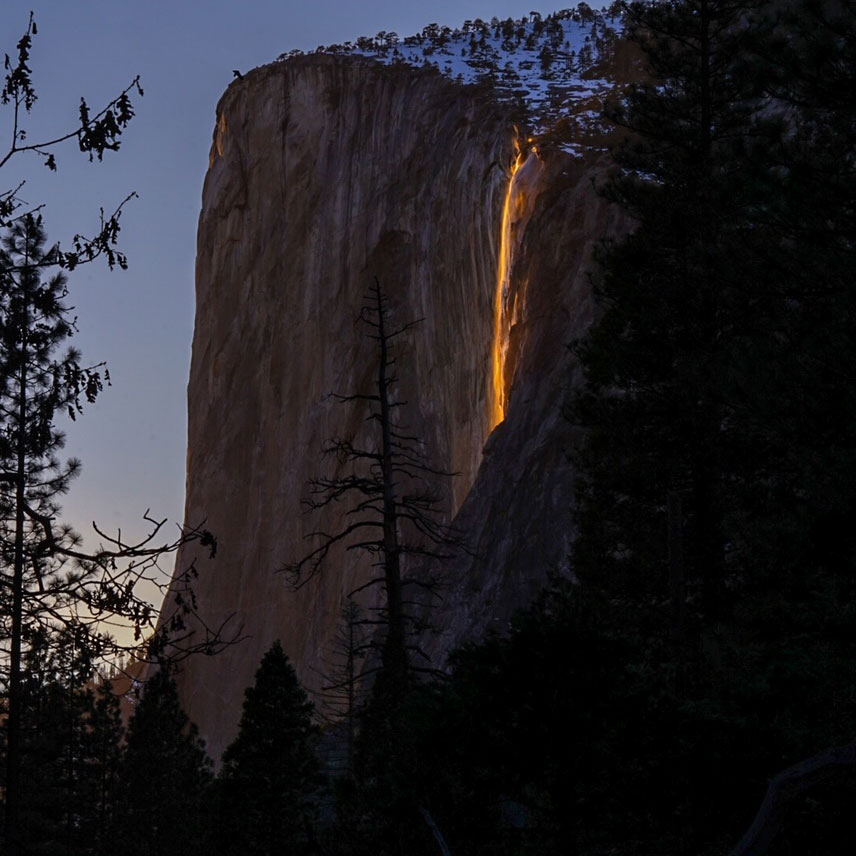
One timing window deserves special mention because it is entirely about light, not water. Horsetail Fall in Yosemite, a roughly 1,570-foot horsetail-type fall fed by seasonal Horsetail Creek, becomes the famous 'firefall' for a brief stretch in mid-to-late February. When the fall is actually flowing from snowmelt and the western sky is clear at sunset, the low sun strikes the thin ribbon of water and lights it up molten orange and red against the dark granite of El Capitan. It demands a specific date range, an unobstructed sunset, and active flow all at once, and it is a vivid reminder that in waterfall photography, you are often photographing a moment of light as much as a place.
Composition: Building the Frame
A waterfall is a strong subject, but a strong subject alone does not make a strong photograph. The most common beginner mistake is centering the fall and nothing else, which produces a record shot, not an image. Instead, give the water a job in the frame. Lead the eye with the flow: position the stream so it carries the viewer's gaze from a corner or edge toward the main drop, and use the plunge pool, the curving creek below, or a line of cascades as a natural path into the picture. The tiered structure of falls like Amicalola or the stacked sections of Yosemite Falls gives you a built-in sense of motion and scale to arrange around.
Foreground is what separates a flat snapshot from a photograph with depth. A wet boulder, a fallen log, a cluster of ferns, or a pattern of swirling foam in the pool gives the eye somewhere to start and a sense of three-dimensional space. Get low and close to that foreground element with a wide lens and the waterfall becomes a dramatic backdrop rather than a distant subject. Watch your edges, too: a stray bright branch or a chunk of blown-out sky in the corner pulls attention straight out of the frame, and it is far easier to recompose a step left than to fix it later.
Include something for scale when the fall is genuinely large, and avoid faking it when it is not. A lone hiker on an overlook, or a recognizable tree at the base, tells the viewer that this curtain of water is taller than a building, information the eye cannot infer from water alone. This matters most at the giants: the sheer drop of Yosemite Falls or the long sweep of Crabtree Falls only reads as enormous when the frame offers a human-sized reference. Remember that the published height is an estimate that varies by source, so let the scale you show be honest to what stood in front of you rather than chasing a number.
Finally, think about shutter speed as a compositional tool, not just an exposure setting. The same waterfall reads completely differently as a one-second silk ribbon versus a frozen 1/1000-second burst of spray, and neither is more 'correct.' A delicate horsetail fall flatters the silky treatment, while a violent plunge may want the frozen energy of fast glass. Shoot both at every location when you can. The discipline of slowing down, leveling the tripod, dialing in the filters, and waiting for the light is itself part of why waterfall photography is so rewarding, and it is a skill that compounds with every creek you stand beside.